What does a painting need before the first line? For Chen Bachar the answer starts long before the canvas: a studio built for inspiration, the right music, the right time and the right materials.
ARTiculAction Art Review asked him how painting, drawing and digital art work together in his practice. His answer is one of the clearest descriptions he has given of his creative process, and it echoes in charcoal drawings such as Osnat.
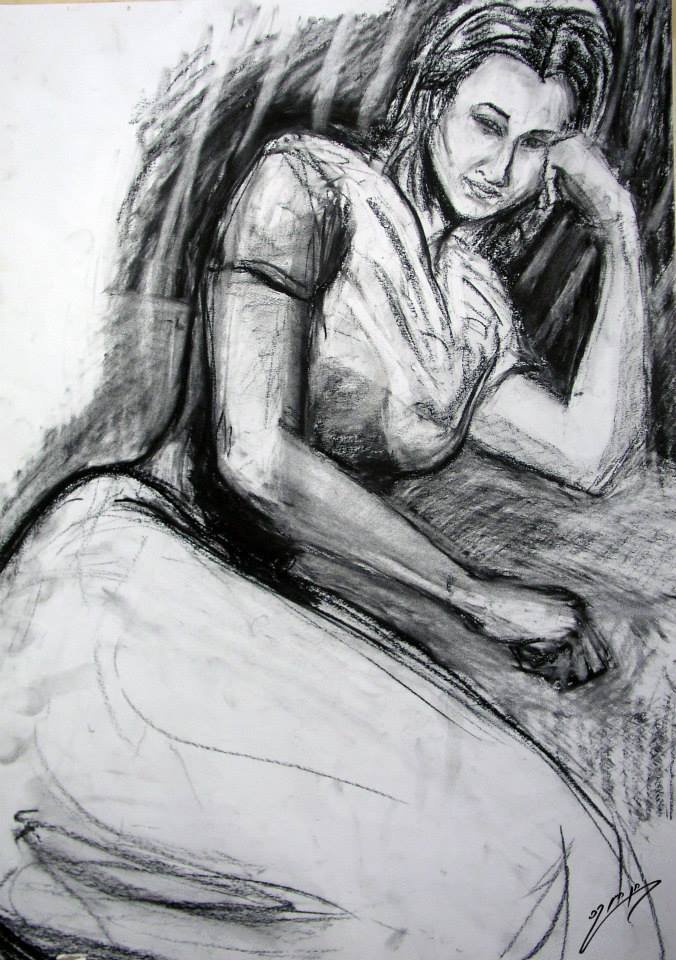
Osnat · Charcoal on paper – View the artwork
The question
Your approach condenses a variety of techniques that ranges from Painting and Drawing to Digital Art, that allows you to explore the expressive potential of the media you select. Would you like to tell to our readers something about your process and set up? In particular, have you ever happened to realize that such synergy is the only way to snatch the spirit of the ideas you explore?
ARTiculAction Art Review – Josh Ryder & Barbara Scott
In Chen's words
Today I use a number of techniques which I collected to get to where I want to express myself, using a rugged texture to show difficulty, strong colors to express any internal shout or often optimism of childhood.
There are several short videos on YouTube in which I revealed the process which I create. A creation is not only the painting itself. It is Very important for me to have the right space, the right time, I built my studio to create a place of inspiration, the right music, with the right materials. Many times the computer is the last thing I touch, giving me a quick and easy solution to get the creation out, there is no doubt that environmental, emotional place, materials and inspirations are a big part of the work process.
There are many moments when I let my hand run on the canvas without thinking about it, just fill the movement of my hand, something I took from the Japanese calligraphy world, I try to be as accurate as I can be, paint motif, however small, over and over again to get realistic as possible.
Chen Bachar
About the work
Osnat is a charcoal study of a seated woman resting her head on her hand. Charcoal is the most direct of Chen’s media: nothing stands between the movement of the hand and the mark on the paper, which is exactly the freedom he describes borrowing from Japanese calligraphy.
The other half of the answer, painting a motif again and again until it becomes realistic, is visible in the same drawing, in the folds of the dress and the careful shading of the face.
Chen’s process videos are on the Videos page.
More from the interview
- Chen Bachar Interview: Ten Questions from ARTiculAction Art Review
- African Woman: The Story Behind Chen Bachar's Oil Painting
- Gipsy: Painting a Woman's Quiet Power
- Thoughts: Between Realism and the Subconscious Line
- Childhood: A Rusty Tricycle as a Self-Portrait
- The Clown and the Question: What Is Art For Today?