
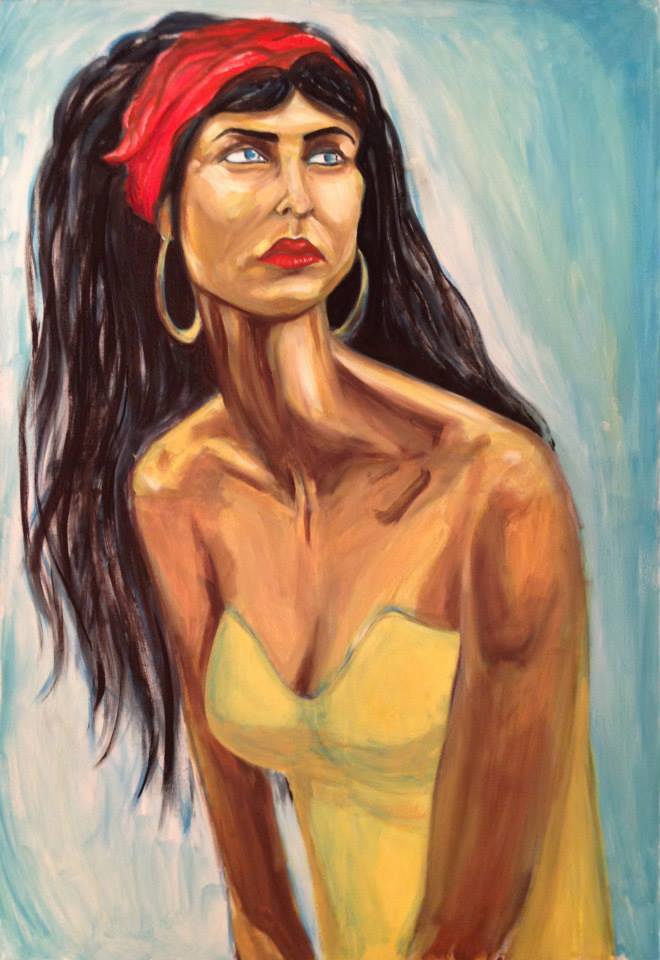
The editors of ARTiculAction Art Review wrote that Gipsy “seems to communicate an attempt to transform tension to harmony”. Chen Bachar’s answer explains where that balance comes from.
The question was asked about two paintings together, African Woman and Gipsy. This is the part of his answer about balance, and about the woman in Gipsy.
Gipsy · Oil on canvas · 120×80 cm – View the artwork
The question
In particular, Gipsy seems to communicate an attempt to transform tension to harmony, and it's really captivating. While walking our readers through the genesis of these pieces, would you shed light to your main source of inspirations?
ARTiculAction Art Review – Josh Ryder & Barbara Scott
In Chen's words
By nature I am trying to find the balance between all the parts. Like writing a musical piece, every vessel playing carries some weight. It's the same in painting, there are my extremists, sharp and strong parts, that connects to a very masculine energy, and tenderness, pleasant, delicate feminine side. That, as I claim is my connection to the feminine side, it is very important for me to find balance between the parts, even the colors, also in the lines, to pass on the authentic feeling.
In "Gipsy" I wanted to emphasize the power of the woman, the power she has in the face of life her incredible patience, her feminine containment against her strengths in her body language, in the colors, the lines and shading.
Chen Bachar
About the work
Gipsy is a large oil portrait of a woman in a red headscarf with dark hair falling over her shoulders, set against loose, open strokes of yellow and blue. Her expression is calm and steady while the background around her moves.
That contrast is the balance Chen describes: sharp and strong against tender and delicate, held together in one composition.
More from the interview
- Chen Bachar Interview: Ten Questions from ARTiculAction Art Review
- Thoughts: Between Realism and the Subconscious Line
- Childhood: A Rusty Tricycle as a Self-Portrait
- The Clown and the Question: What Is Art For Today?
- Steve Jobs: Why the Portrait Is Split Across Two Canvases
- John Lennon: A Pop-Art Portrait Built on Colour Psychology