
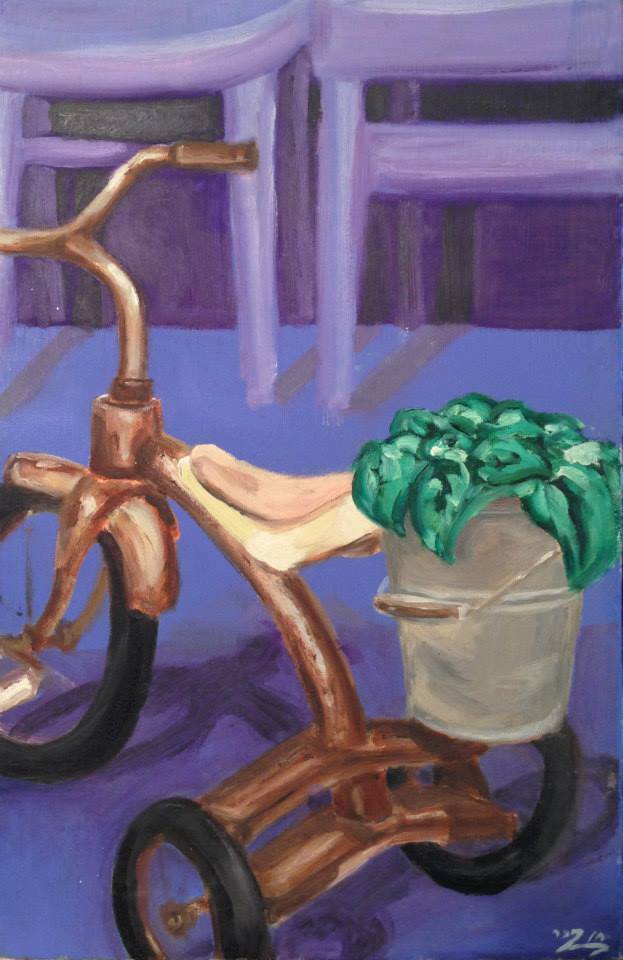
There is no person in Childhood. There is an old tricycle, and behind it two chairs. Chen Bachar painted himself anyway.
ARTiculAction Art Review noted that his paintings often avoid an explicit explanation and invite viewers to find their own reading. Then it asked about the role memory plays in his work. The answer is the most personal moment of the interview.
Childhood · Oil on canvas · 50×30 cm – View the artwork
The question
While exhibiting a captivating vibrancy, your pieces sometimes reject an explicit explanatory strategy: rather, in Childhood you seem to invite the viewer to find personal interpretations to the feelings that you convey into your paintings. What is the role of memory in your process? And in particular, do you try to achieve a faithful visual translation of your feelings?
ARTiculAction Art Review – Josh Ryder & Barbara Scott
In Chen's words
The painting "Childhood" has an old tricycle and behind it two different chairs. The tricycle, in my feeling at that time, felt like me. Something of Child, of the happy childhood that ended a long time ago.
During that period I connected to my inner child, especially the wounded child who did not get the correct listening from his parents. They did not understand I am an artist and pushed me toward computers. This is the stage of adolescence where I saw myself indeed abandoned and rusty yet with the joy of life that Tricycle is giving, the memories that cannot be taken, optimism and understanding that my life is not the same as my parents.
The tricycle as a metaphor of my childhood, truly broken and sad, but still emphasizes that it holds blossoming optimism, the blossoming of life when you understand what you need to learn and take in life. Understand that you are stronger than you thought, always remain optimistic and look at life differently.
The chairs standing there and "looking" at the tricycle do not transfer emotion and connection, just as I felt many times during my childhood. I like this painting because it gives me both the joy and sadness. the playfulness and toughness, the monochromes of memories.
Chen Bachar
About the work
Childhood is a small oil painting, and its meaning sits in a few objects: a child’s tricycle, rust, two empty chairs. It is a clear example of how Chen turns a still life into a portrait of a feeling.
The story behind it, a boy pushed toward computers, links to the end of the interview, where Chen tells how he went from computer programmer to painter.
More from the interview
- Chen Bachar Interview: Ten Questions from ARTiculAction Art Review
- The Clown and the Question: What Is Art For Today?
- Steve Jobs: Why the Portrait Is Split Across Two Canvases
- John Lennon: A Pop-Art Portrait Built on Colour Psychology
- Venice and the Choice of Materials: Oil, Watercolour, Spices and Sand
- Amy Winehouse: Between Speaking to the Audience and Staying Mysterious